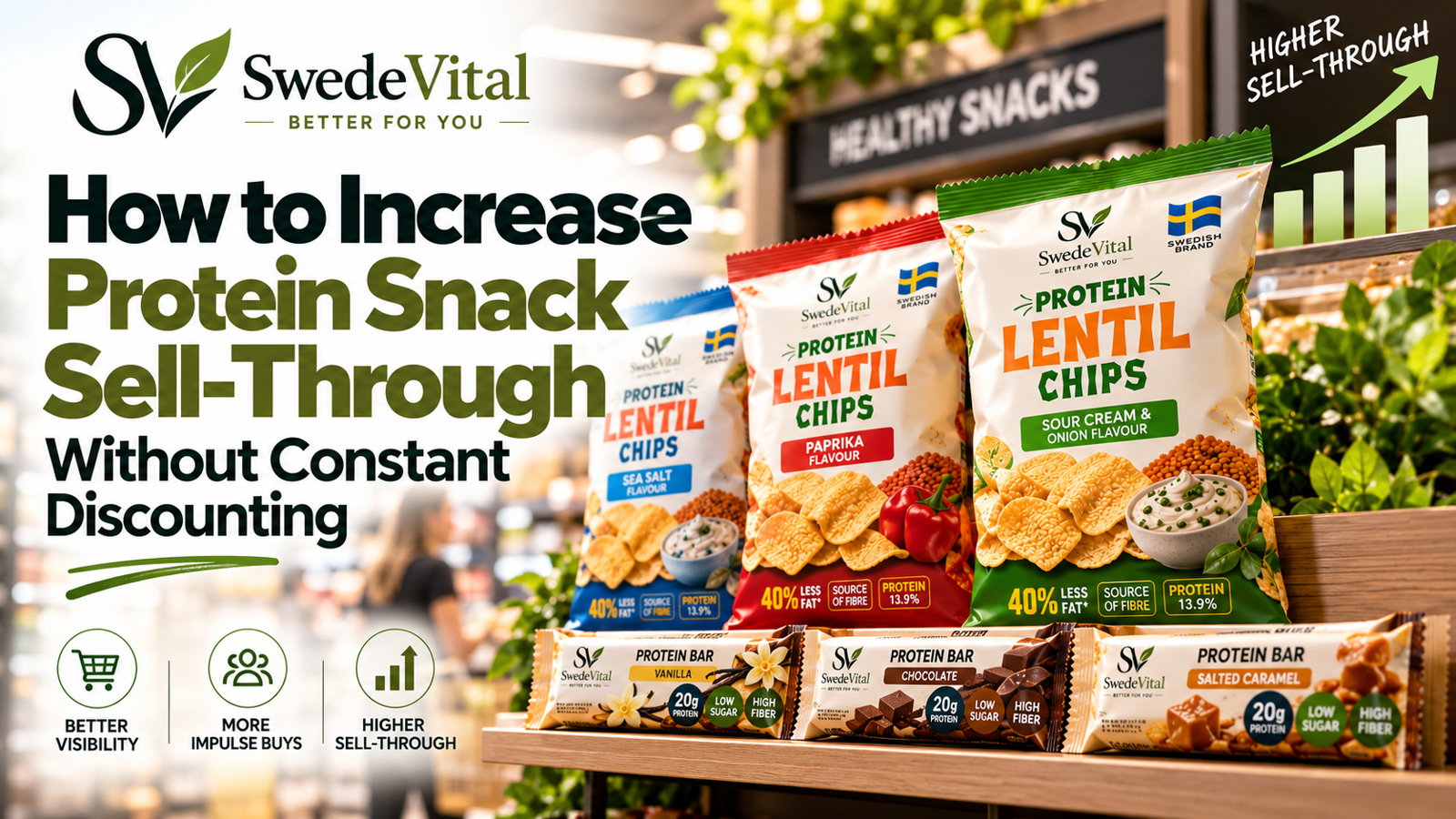
Protein Snack Merchandising: A Practical Guide for Retailers
Kort sammanfattat
Protein snack merchandising means ranging, placing and presenting high-protein snacks so shoppers find and repeat-buy them. Define shopper missions, give the range a signed primary home in better-for-you snacking, cover formats before flavours, build a clear price ladder, and add high-intent secondary sitings at checkout and the chiller.
TL;DR
- Manage protein snacks as one coherent, mission-led sub-category with a signed primary home, full format coverage, an honest price ladder and high-intent secondary sitings.
Protein snack merchandising is the discipline of ranging, placing and presenting high-protein snacks so shoppers find them fast, understand them at a glance, and come back for them. Done well, it converts a crowded, fast-growing category into a dependable margin driver: coherent on-shelf blocking, honest claims, sensible price tiers, and secondary placements at the moments shoppers actually decide — the chiller, the checkout, and the food-to-go fixture. This guide is written for retail buyers, category managers and store owners deciding what to stock and how to build the fixture around it.
Why protein snack merchandising is a category, not an afterthought
Protein has moved from the gym bag into the everyday basket. Interest in high protein foods is now one of the largest sustained trends in grocery, and shoppers increasingly read protein as a proxy for “a snack I can feel good about.” That creates an opportunity and a trap. The opportunity is incremental, higher-value snacking occasions. The trap is treating protein products as scattered line extensions inside confectionery, sports nutrition and free-from — where they compete with themselves, confuse the shopper, and never build a recognisable destination.
The fix is to manage protein snacks as a coherent sub-category with its own logic. Decide what the block stands for, which missions it serves, and how a shopper navigates from “I want something high in protein” to a confident choice in under ten seconds. Research consistently suggests that clear category structure and easy comparison reduce decision friction; a fragmented protein set does the opposite.
Start with shopper missions, not products
Before you touch a planogram, define who you are merchandising for. Most protein snacking splits into a handful of missions, and each implies a different location, adjacency and price expectation:
- Everyday better-for-you snacking. Shoppers trading up from crisps and biscuits. They want healthy snacks that taste good and carry a credible protein claim — think protein chips, savoury bites and lighter bars. This mission belongs in mainstream snacking, not hidden in sports nutrition.
- Active and post-workout. Higher-protein bars and bites bought with intent. These shoppers read the numbers and tolerate a premium.
- On-the-go meal bridging. A snack that stands in for a skipped meal. Format and satiety matter more than flavour novelty.
- Low-sugar and functional. Shoppers managing sugar or adding function (for example, wellness formats). They scan back-of-pack and reward transparency.
You will not serve every mission with equal weight, and you should not try. Pick the two or three that fit your shopper base and let that decision drive range depth and location.
Where protein snacks belong in the store
Location is the single biggest lever here, because the same product performs very differently by mission. Use a primary home plus deliberate secondary sitings:
Primary home
Give the everyday better-for-you range a permanent block within mainstream snacking, ideally adjacent to nuts, seeds and cereal bars where the “healthier snack” shopper is already browsing. This is where protein bars, protein chips and natural bites earn repeat, planned purchases. A dedicated, well-signed block signals authority and makes the category findable.
Secondary sitings
Place high-intent formats where the mission occurs: single bars and bites at checkout and food-to-go for impulse and meal-bridging; chilled protein items in or beside the drinks chiller for the active mission; and functional-wellness formats near vitamins and supplements. Secondary sitings capture the occasion without diluting the primary block.
Build a range that covers formats, not just flavours
Buyers commonly over-index on flavour variety and under-index on format. Shoppers choose format first — bar, chip, bite, gummy — then flavour. A resilient protein set covers the format grid before it multiplies flavours:
- Bars for the recognisable, high-protein anchor and the active mission.
- Savoury protein chips to convert crisp buyers and own the “better crisp” occasion.
- Bites and natural bites for sharing, portion control and everyday snacking.
- Functional formats (for example capsules, sprays, gummies and sleep or recovery support) where you serve the wellness mission — kept honest with evidence-led, non-committal claims.
As a supplier note relevant here: SwedeVital’s range spans plant-based protein snacks — protein lentil chips, protein bites, natural bites and protein bars — alongside a functional-wellness line, which lets a buyer cover several formats and missions from one relationship, including private-label options. Use that breadth to fill format gaps rather than to widen an already crowded flavour wall.
Rule of thumb: add a new format only when it serves a distinct mission; add a new flavour only when it out-earns the weakest line it would replace.
Merchandise the shelf for a ten-second decision
Once range and location are set, the fixture has to do the selling. Protein shoppers compare on a small number of attributes — protein grams, sugar, calories, format and price — so make those comparable at a glance:
- Block by mission, then by format. Vertical brand blocks within each mission help the eye scan and reduce the “wall of bars” effect.
- Lead with one honest hero claim. A single clear protein claim beats a cluttered flag of six. Keep claims accurate and compliant; over-claiming erodes trust and repeat.
- Sequence by price and intensity. Arrange from accessible everyday options to higher-protein, higher-price tiers so shoppers can trade up within the block.
- Protect availability on the anchors. The best-selling bar or chip drives the whole block; an out-of-stock hero costs sales across the fixture. Prioritise facings and replenishment on proven anchors.
- Use shelf-edge education. Brief, factual call-outs (“source of protein”, “plant-based”, “no added sugar” where true) help undecided shoppers self-qualify without staff intervention.
Price architecture, margin and promotions
Protein snacks carry a value halo, which supports firmer pricing than standard confectionery — but only if the fixture makes the value legible. Build a deliberate price ladder rather than a single tier:
- An entry price that lets a crisp or biscuit buyer try the category without a leap.
- A core tier where most volume and margin sit, held on shelf with strong availability.
- A premium or functional tier for the active and wellness missions, justified by higher protein or added function.
On promotion, be selective. Deep, frequent discounting on protein snacks trains shoppers to wait and erodes the value perception the category depends on. Multi-buys that build the basket (mix-and-match across formats) or trial-driving intro offers on new formats tend to protect margin better than blanket price cuts. Track rate of sale and margin per facing, not just headline units, and prune persistent underperformers so the block stays sharp.
Cross-merchandising that lifts the basket
Protein snacks pair naturally with adjacent missions, and thoughtful cross-merchandising captures occasions the main block cannot:
- Drinks and chiller: protein bars and bites beside water, coffee-to-go and sports drinks for the active occasion.
- Breakfast and food-to-go: grab-and-go singles for meal bridging at commuter and lunch peaks.
- Health and wellness: functional formats near vitamins and supplements, where the shopper is already in a wellness mindset.
- New Year and seasonal resets: temporary features when demand for high protein foods and healthier snacking spikes.
Keep secondary displays small, well-stocked and honest. A tidy four-facing siting at the point of intent usually out-earns a large, poorly maintained one.
A protein snack merchandising checklist for retailers
Use this as a practical pre-range and shelf-review checklist:
- Missions defined. You have named the two or three shopper missions this block serves.
- Primary home secured. A permanent, signed block sits within mainstream snacking, near related better-for-you products.
- Format grid covered. Bars, chips and bites are represented before flavour variety is widened.
- Anchors protected. Best-sellers have extra facings and a replenishment rule to prevent out-of-stocks.
- Claims honest and clear. One hero claim per pack; all protein and health claims are accurate, compliant and evidence-led.
- Price ladder built. Entry, core and premium tiers are visible and logically sequenced.
- Secondary sitings placed. High-intent singles sit at checkout, chiller and food-to-go.
- Performance tracked. Rate of sale and margin per facing are reviewed, with a rule to prune the weakest lines.
Protein snack merchandising is not a one-time planogram exercise; it is an ongoing loop of mission, placement, presentation and pruning. Buyers who treat it that way turn a hype-prone category into a durable, repeat-driving part of the store.
Frequently asked questions
What counts as a high-protein snack for merchandising purposes?
Treat “high protein” as a claim governed by labelling rules in your market rather than a marketing adjective. For fixture logic, group products that shoppers reach for specifically to add protein — bars, protein chips, bites and comparable formats — and make the protein content easy to compare on shelf. Always follow local regulations on when “high in protein” or “source of protein” may be used.
Where should protein bars sit in the store?
Give protein bars a primary home in mainstream better-for-you snacking, near cereal bars, nuts and seeds, where planned purchases happen. Add secondary sitings of singles at checkout, food-to-go and the drinks chiller to catch impulse and post-workout occasions. The dual placement captures both the planned and the in-the-moment shopper.
Are protein snacks really healthy snacks?
Some are a genuinely better choice than standard confectionery, but “protein” on the front does not automatically make a product a healthy snack. Sugar, fat and calorie content still vary widely. Merchandise honestly: let shoppers compare the full nutrition panel, avoid over-claiming, and range options that stand up to scrutiny so the category keeps its trust and repeat.
How much range should a protein snack block carry?
Cover the format grid first — at least bars, savoury chips and bites — then add flavours only where they out-earn the weakest line. Depth should match the missions you have chosen and your space; a tight, well-signed set that stays in stock usually beats a sprawling one riddled with gaps.
Should protein snacks be promoted, and how?
Promote selectively. Because the category trades on a value halo, deep and frequent discounting can erode price perception and train shoppers to wait. Favour trial offers on new formats and basket-building multi-buys over blanket price cuts, and judge every promotion on margin and incremental rate of sale, not headline volume alone.
How do I decide which protein products to stock?
Work backwards from missions and format gaps, then evaluate suppliers on range breadth, claim integrity, availability and private-label flexibility. A partner who can supply several formats — for example plant-based chips, bites and bars plus functional lines — lets you fill the format grid and adapt the block without juggling many relationships.
Vanliga frågor
What counts as a high-protein snack for merchandising purposes?
Treat 'high protein' as a claim governed by labelling rules in your market, not a marketing adjective. For fixture logic, group products shoppers reach for specifically to add protein - bars, protein chips and bites - and make protein content easy to compare on shelf, always following local regulations on protein claims.
Where should protein bars sit in the store?
Give protein bars a primary home in mainstream better-for-you snacking near cereal bars, nuts and seeds for planned purchases, then add secondary sitings of singles at checkout, food-to-go and the drinks chiller to catch impulse and post-workout occasions.
Are protein snacks really healthy snacks?
Some are a genuinely better choice than standard confectionery, but a protein claim does not automatically make a product a healthy snack, because sugar, fat and calories still vary. Merchandise honestly, let shoppers compare the full nutrition panel, and range options that withstand scrutiny.
How much range should a protein snack block carry?
Cover the format grid first - at least bars, savoury chips and bites - then add flavours only where they out-earn the weakest line. Match depth to your chosen missions and space; a tight, in-stock set usually beats a sprawling one full of gaps.
Should protein snacks be promoted, and how?
Promote selectively. The category trades on a value halo, so deep, frequent discounting erodes price perception. Favour trial offers on new formats and basket-building multi-buys over blanket cuts, and judge each promotion on margin and incremental rate of sale, not headline volume.
How do I decide which protein products to stock?
Work backwards from shopper missions and format gaps, then evaluate suppliers on range breadth, claim integrity, availability and private-label flexibility. A partner able to supply several formats lets you fill the format grid and adapt the block without juggling many relationships.