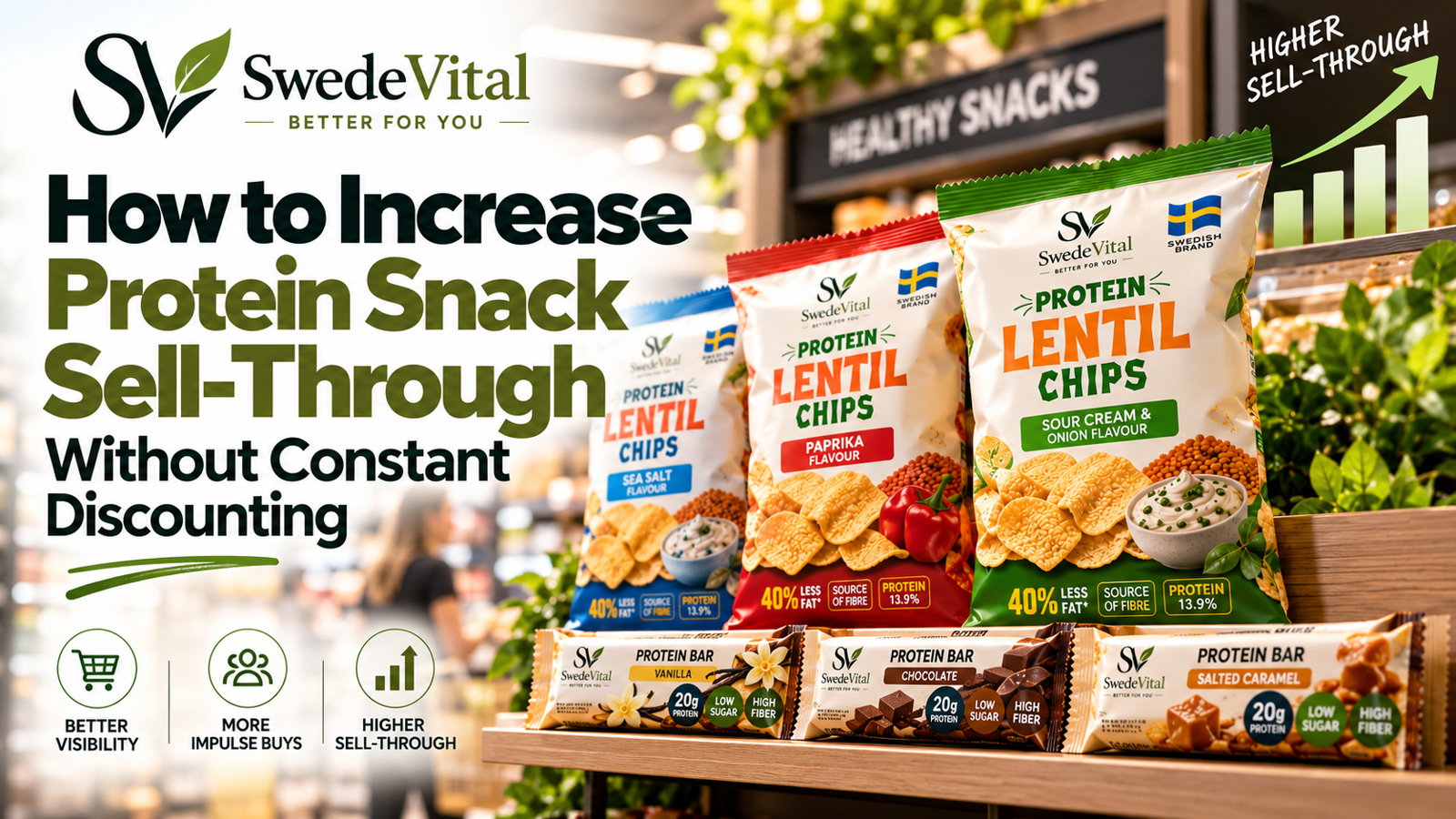
How to Test a New Protein Snack Brand Before a Full Retail Rollout
Kort sammanfattat
Test a new protein snack brand for retail with a controlled, time-boxed pilot in representative stores or one online channel, judged against pre-agreed targets for rate of sale, repeat purchase and true margin. Then scale, iterate or delist on the evidence before committing shelf space chain-wide.
TL;DR
- Pilot a new protein snack brand in a representative store cluster against pre-agreed rate-of-sale, repeat-purchase and margin thresholds, then scale, iterate or delist on the evidence.
The safest way to test a new protein snack brand for retail is to run a controlled, time-boxed pilot in a small set of representative stores (or one online channel) and judge it against pre-agreed targets for rate of sale, repeat purchase and margin — before you give it permanent shelf space chain-wide. A structured test turns a stocking decision from a gut call into evidence, protecting your planogram, your working capital and your supplier relationships.
Shopper appetite for protein is broad and deep. Search interest in the wider category — from protein powder to bars, bites and chips — is consistently high, and much of it is informational, with buyers comparing formats and labels before they commit. But that momentum does not transfer automatically to a snack format or to any single brand. The job of a retail test is to find out whether this product, at your price, on your shelf, actually moves.
Why you should test a protein snack brand before a retail rollout
A full rollout commits three scarce things at once: shelf space, cash tied up in inventory, and the credibility you spend when you ask store teams to make room. Get it wrong and you carry slow stock, mark it down, and lose the facing to a proven line. A staged test caps that downside. It lets you learn the product's real rate of sale, its repeat rate, and its operational quirks (case pack, shelf life, merchandising needs) at a scale where mistakes are cheap and reversible.
Testing also rebalances the negotiation. When you can show a supplier hard pilot data, listing fees, marketing support and terms become an evidence-based conversation rather than a leap of faith. And it disciplines the supplier too: a brand confident in its product will welcome a measured trial. Reluctance to be tested is itself a data point.
Define what success looks like before the first case ships
The most common testing mistake is running a pilot with no exit criteria, then arguing about the result afterwards. Decide the thresholds first, in writing, with the supplier aware of them. At minimum, agree targets for:
- Rate of sale — units per store per week, the single clearest signal of genuine demand.
- Repeat purchase — whether the same shoppers come back, which separates a novelty spike from a real habit.
- Margin after all costs — landed cost, listing or slotting contributions, expected wastage and any markdown risk near end of shelf life.
- Basket and cannibalisation — does the newcomer grow the category, or just steal sales from a line you already stock?
- Operational fit — case pack, minimum order quantity, replenishment reliability and shelf-life headroom on delivery.
Write down what "pass", "iterate" and "delist" each look like. A pilot with defined thresholds ends in a decision; a pilot without them ends in a debate.
Choose the right test format
There is no single correct way to test a protein snack brand for retail — the format should match your footprint and your risk appetite. The main options each trade speed against signal quality.
Single-store or small cluster
Cheapest and fastest to set up, and useful for spotting obvious operational problems. The weakness is sample size: one store's quirks (a strong local following, an unusual demographic) can flatter or bury a product. Treat it as a smoke test, not a verdict.
Regional or representative cluster
A handful of stores chosen to mirror your estate — different sizes, demographics and regions — gives a far more reliable read. This is the workhorse format for most retail tests: large enough to average out noise, small enough to contain the downside.
Online or app-only pilot
Listing the range on your e-commerce channel first surfaces demand with minimal physical risk and rich data on who buys and what they buy alongside. It is a strong early filter, but remember online browsing behaviour does not perfectly predict impulse-driven physical shelf performance.
Private-label or exclusive trial
If the appeal is a format rather than a specific brand name, a private-label or exclusive test lets you own the margin and the customer relationship. It demands more upfront work on specification, quality assurance and packaging, so it suits categories where you already see steady, proven demand.
Vet the brand and product before it reaches the shelf
Half of a good test happens before any unit sells. Due diligence protects you from problems a shelf trial cannot fix. Work through the essentials:
- Compliance and labelling — confirm that nutrition and health claims meet the relevant regulations in your market, that allergens are declared correctly, and that any functional or protein claims are substantiated rather than aspirational.
- Food-safety and quality systems — ask for the manufacturer's certifications, audit history, traceability and recall procedures. A newcomer that cannot document these is a risk regardless of taste.
- Supply reliability — lead times, capacity headroom, and a realistic MOQ you can actually sell through within shelf life. A product that sells out and then vanishes for six weeks damages the category.
- Shelf life and stability — confirm remaining shelf life on delivery and how the product holds up under real store conditions and handling.
- Differentiation — be honest about why a shopper would pick this over what you already stock. Novelty fades; a genuine reason to exist does not.
A brand worth stocking can answer sourcing, compliance and supply questions without hesitation. Vagueness on any of them is a reason to slow down, not speed up.
Design the shelf test so the result is trustworthy
Once a product clears due diligence, the test design determines whether you can believe the numbers. Control the variables you can:
- Placement — put it where a shopper would reasonably look for a protein snack, not on a dump bin that flatters or a bottom shelf that buries it. Match placement across test stores so you are comparing like with like.
- Facings and stock — give it enough facings and depth to avoid out-of-stocks that would understate demand.
- Price — test at the price you would actually charge at rollout. A promotional launch price tells you about deal-seekers, not sustainable demand; if you do promote, plan to measure the post-promotion baseline too.
- Duration — run long enough to capture repeat purchase, not just trial. A few weeks reveals curiosity; a longer window reveals a habit. Impulse snacks can read faster than considered purchases, but give repeat behaviour time to appear.
- Support — keep launch marketing consistent across test stores, or you will measure the marketing rather than the product.
Line up a control where you can — comparable stores without the product, or the category's prior baseline — so you can separate the newcomer's contribution from seasonal or footfall swings.
Read the data and make the call
When the window closes, interpret the numbers against the thresholds you set, not against how you feel about the product. Prioritise the signals in this order:
- Rate of sale versus target — is it clearing the bar you agreed, consistently, across stores rather than in one outlier?
- Repeat rate — a healthy return rate is the strongest evidence of durable demand and the best predictor of rollout performance.
- Incrementality — did total category sales grow, or did the newcomer simply cannibalise an existing line? Growth justifies the space; substitution rarely does.
- Margin reality — recompute margin with actual wastage and any markdowns included, not the tidy figure from the proposal.
- Operational behaviour — were deliveries reliable, was the case pack workable, did stores flag any handling problems?
Then choose one of three outcomes: scale (it beat the thresholds — expand in defined phases, not everywhere at once), iterate (promising but short on one dimension — adjust price, placement or pack and retest), or delist (it missed the bar — reclaim the space cleanly). Phasing the scale-up matters: even a strong pilot should roll out in waves so supply and replenishment keep pace with demand.
A practical checklist to test a protein snack brand for retail
Use this as a repeatable gate for any protein-snack newcomer, whether it is a protein lentil chip, a protein bite, a natural bite or a bar:
- Agree pass/iterate/delist thresholds for rate of sale, repeat rate and true margin, in writing.
- Complete compliance, food-safety, shelf-life and supply due diligence before ordering.
- Select a representative store cluster (or a clean online pilot) rather than a single flattering site.
- Set placement, facings, price and duration to mirror real rollout conditions.
- Keep marketing support consistent and establish a control or baseline.
- Measure repeat purchase and incrementality, not just first-week trial.
- Recompute margin with real wastage and markdowns.
- Decide against the thresholds, then scale in phases, iterate, or delist.
For buyers exploring this category, SwedeVital's range — protein lentil chips, protein bites, natural bites and protein bars, alongside a functional-wellness line — is built to be trialled this way, with the specification and supply detail a proper retail test depends on.
Frequently asked questions
How long should a protein snack retail test run?
Long enough to capture repeat purchase, not just first-time trial. Impulse snacks can show a rate-of-sale signal within a few weeks, but a longer window reveals whether shoppers come back and buy again — the behaviour that actually predicts rollout success.
How many stores do I need for a reliable test?
Enough to average out the quirks of any single site. A single store is only a smoke test; a small cluster chosen to represent your estate — varied by size, region and demographic — gives a read you can trust while keeping the downside contained.
Does high demand for products like protein powder mean protein snacks will sell?
Not directly. Strong, largely informational interest in the wider protein category shows appetite, but format matters: a shopper researching protein powder is not necessarily reaching for a snack. Test the specific product and format rather than assuming category momentum carries over.
Should I test a branded product or go straight to private label?
Test the branded product first when you are unsure demand exists; it is faster and lower-commitment. Consider private label once you have proven steady demand for the format and want to own the margin and customer relationship — it needs more upfront work on specification and quality assurance.
What is the single most important metric?
Repeat purchase rate. Rate of sale tells you there is initial interest, but repeat purchase is the clearest evidence of durable demand and the best predictor of how the product will perform at full scale.
What if a supplier resists being tested?
Treat reluctance as information. A brand confident in its product generally welcomes a measured trial and can answer sourcing, compliance and supply questions readily. Hesitation to be evaluated on evidence is a reason to slow down before committing shelf space.
Vanliga frågor
How long should a protein snack retail test run?
Long enough to capture repeat purchase, not just first-time trial. Impulse snacks can show a rate-of-sale signal within a few weeks, but a longer window reveals whether shoppers come back and buy again, which is what actually predicts rollout success.
How many stores do I need for a reliable test?
Enough to average out the quirks of any single site. One store is only a smoke test; a small cluster chosen to represent your estate by size, region and demographic gives a read you can trust while keeping the downside contained.
Does high demand for products like protein powder mean protein snacks will sell?
Not directly. Strong, largely informational interest in the wider protein category shows appetite, but format matters: a shopper researching protein powder is not necessarily reaching for a snack. Test the specific product and format rather than assuming category momentum carries over.
Should I test a branded product or go straight to private label?
Test the branded product first when you are unsure demand exists; it is faster and lower-commitment. Consider private label once you have proven steady demand for the format and want to own the margin, since it needs more upfront work on specification and quality assurance.
What is the single most important metric?
Repeat purchase rate. Rate of sale shows there is initial interest, but repeat purchase is the clearest evidence of durable demand and the best predictor of how a product will perform at full scale.
What if a supplier resists being tested?
Treat reluctance as information. A brand confident in its product generally welcomes a measured trial and can answer sourcing, compliance and supply questions readily. Hesitation to be evaluated on evidence is a reason to slow down before committing shelf space.