
Reishi for Everyday Wellness: What Consumers Should Know
Kort sammanfattat
Reishi mushroom wellness is a traditional tonic used for stress relief, sleep support, and general resilience. It’s best taken as a supplement over weeks, not days, and comes in capsules, dual‑extract sprays, or gummies. Choose products made from the fruiting body, with clear extract claims, and avoid overstated medical claims.
TL;DR
- Reishi mushroom wellness supports stress relief, sleep, and resilience as a slow‑acting tonic, available in capsules, sprays, or gummies, with quality indicated by fruiting body extracts and clear labeling.
Reishi mushroom wellness refers to the everyday, preventative use of Ganoderma lucidum — a woody, bitter medicinal mushroom that has been used in East Asian herbal traditions for more than two thousand years. Today it is taken as a supplement in capsule, spray or gummy form, most often to help people wind down, manage the effects of everyday stress and support general resilience. Reishi is not a medicine and it is not a quick fix; research is ongoing and the honest position is that it is a traditional tonic being studied for a range of supportive roles, best judged over weeks rather than days.
This primer is written for shoppers weighing up whether Reishi belongs in their routine, and for the retail buyers and category managers who serve them. It explains what Reishi is, what the evidence does and does not say, how the different formats compare, how to read a label, and who should be cautious — without hype and without overclaiming.
What is Reishi, and why the interest in Reishi mushroom wellness?
Reishi (known as lingzhi in Chinese and reishi in Japanese) is a shelf-like polypore that grows on hardwood. Unlike culinary mushrooms, it is too tough and bitter to eat as food, so it has always been prepared as a decoction, extract or powder. In traditional Chinese and Japanese herbalism it was classified as a "superior" tonic herb — something taken regularly by generally healthy people to support longevity and calm, rather than a remedy reached for only when unwell.
That framing is exactly why this has become such a fast-growing modern category. The contemporary interest is driven by three things: a broad consumer shift toward "functional" foods and adaptogens; a desire for non-stimulant options that support rest rather than energy; and a growing body of preliminary research into the compounds Reishi contains. The most studied of these are beta-glucans (a type of polysaccharide) and triterpenes (including ganoderic acids), which are the focus of much of the laboratory and early clinical work.
Reishi is best understood as a slow, cumulative tonic — a "some days you notice, most days you don't" ingredient rather than a supplement with an obvious immediate effect.
What research suggests about Reishi mushroom wellness — and what it does not
Honesty about the science is the foundation of trust here. Reishi has been studied for several supportive roles, but most human trials are small, short or of variable quality, and results are not consistent enough to make firm promises. What can fairly be said is measured:
- Stress, relaxation and sleep quality: Reishi is traditionally used to promote calm and restful sleep, and it is one of the main reasons people take it today. Some small studies have explored effects on fatigue and sleep, but the evidence is early.
- Immune modulation: The beta-glucans in Reishi have been studied for their interaction with the immune system in laboratory and animal models. Research suggests a modulating role, but this should not be read as a claim to prevent or treat any infection or illness.
- General resilience and "adaptogenic" support: Reishi is often grouped with adaptogens — substances traditionally used to help the body cope with everyday stress. This is a traditional-use framing, not an authorised medical claim.
Just as important is what Reishi is not. It is not a treatment for any disease, it is not a substitute for prescribed medication, and no responsible supplier should imply otherwise. Under EU rules, food supplements may not carry claims to prevent, treat or cure illness. The trustworthy way to talk about Reishi is with words like traditionally used for, has been studied for and may support — and to let people judge the results for themselves.
Capsules, sprays or gummies: choosing a Reishi format
Reishi is sold in several formats, and the right one depends on how someone wants to take it, not on which is "strongest" in the abstract. Each has genuine trade-offs.
Capsules
Capsules are the workhorse format: precise, unflavoured (which matters, because Reishi is genuinely bitter), easy to dose and easy to travel with. They suit people who want a consistent daily amount and do not want to taste anything. The main consideration is what is inside the capsule — extract versus raw powder — which the label should make clear (see the checklist below).
Dual-extract sprays
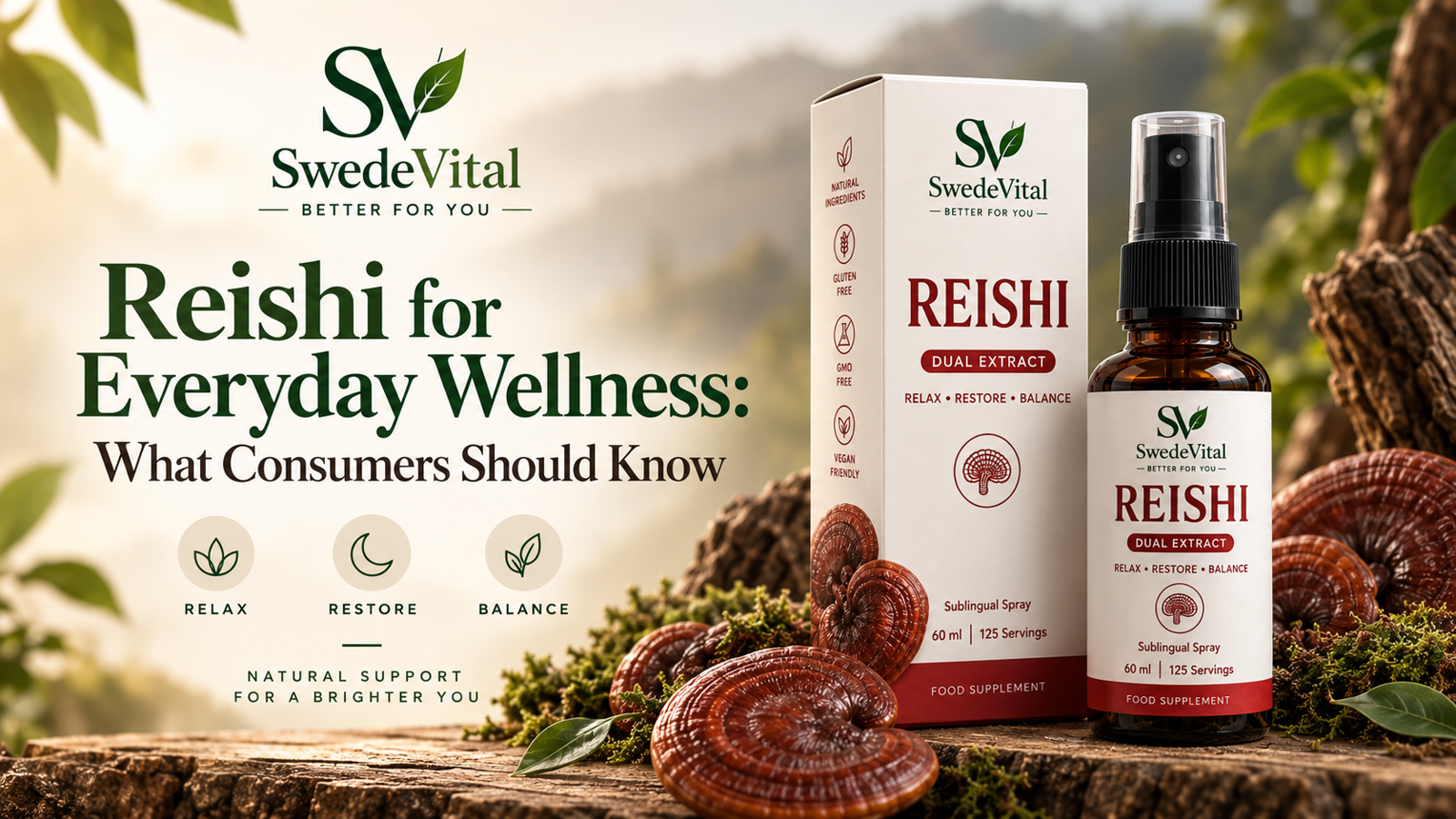
A dual-extract spray delivers a liquid concentrate under the tongue. The "dual extraction" refers to using both hot water and alcohol to capture two different families of compounds: water pulls out the beta-glucans, while alcohol pulls out the triterpenes. Sprays are convenient for people who dislike swallowing capsules and want fast, flexible dosing, though the taste is more noticeable.
Gummies
Gummies trade some potency and precision for palatability and routine-friendliness. They are the easiest format to remember to take and the most pleasant, which for many people is the difference between a supplement that gets used and one that sits in a cupboard. The trade-off is that gummies carry less active material per serving and usually add sugar or sweeteners, so the label detail matters more.
SwedeVital's functional-wellness range spans all three approaches — Reishi capsules, dual-extract sprays and gummies — precisely because format is a matter of fit. A category buyer stocking Reishi will typically want more than one, because the capsule buyer and the gummy buyer are often different people.
How to read a Reishi label: a quality checklist
The Reishi market ranges from excellent to close to worthless, and the difference is usually invisible in the marketing but visible on the label. Use this checklist when comparing products:
- Fruiting body vs mycelium. Look for products made from the Reishi fruiting body (the actual mushroom) rather than mycelium grown on grain, which can be diluted with the starch it was grown on. Good labels state this plainly.
- Extract, not just powder. Because Reishi is woody, an extract concentrates the active compounds far better than raw milled powder. A "dual extract" indicates both water- and alcohol-soluble compounds have been captured.
- Beta-glucan content, not just "polysaccharides". The most useful labels state beta-glucan percentage. A high "polysaccharide" figure can be inflated by grain-derived starch, so it is a weaker signal than a specific beta-glucan number.
- A stated extract ratio. Figures such as 8:1 or 10:1 tell you how much raw material went into the extract, giving a sense of concentration.
- Third-party or contaminant testing. Because mushrooms can accumulate heavy metals, reputable suppliers test for them. Look for a mention of testing rather than assuming it.
- A clean, honest ingredient list. Fewer fillers is better; for gummies, check the sugar and sweetener content.
- Origin and traceability. Knowing where the mushroom was grown and processed is a reasonable expectation, not a luxury.
If a product will not tell you which part of the mushroom it uses or whether it is an extract, that silence is itself an answer.
Fitting Reishi into an everyday routine
Because Reishi is a cumulative tonic, consistency matters more than intensity. A few practical principles help people get a fair trial of it:
- Pick a time and stick to it. Many people take Reishi in the evening, aligning with its traditional use for winding down, though there is no rule requiring it.
- Give it weeks, not days. A reasonable trial is several weeks of daily use before deciding whether it earns a place in the routine.
- Start modestly. Follow the serving guidance on the pack rather than assuming more is better.
- Judge it on your own terms. Sleep, calm and how you handle stressful days are personal and subjective — keep a loose note of how you feel rather than expecting a dramatic switch.
Reishi also pairs conceptually with the wider functional-mushroom family. Lion's Mane is more associated with focus and cognitive support, Cordyceps with energy and stamina, and Turkey Tail with immune and gut research — while Reishi occupies the "calm and resilience" corner. Consumers exploring the category often want to understand these differences, and retailers who explain them build more trust than those who sell a single hero product.
Who should be cautious with Reishi
Reishi is generally well tolerated when used as directed, but "natural" does not mean "risk-free for everyone". Some groups should be careful or seek professional advice first:
- People on blood-thinning or blood-pressure medication: Reishi has been studied for effects that could theoretically interact with these medicines, so a conversation with a doctor or pharmacist is sensible.
- Anyone scheduled for surgery: because of the same theoretical effect on bleeding, it is commonly advised to pause supplements beforehand.
- Pregnant or breastfeeding women: there is not enough safety data, so caution is the default.
- People with existing conditions or on multiple medications: a quick check with a healthcare professional is the responsible step.
Mild digestive upset or dryness of the mouth and throat are the side effects most commonly reported, and these tend to be minor. None of this is medical advice — it is a prompt to involve a professional when there is any doubt.
Why Reishi belongs in a considered wellness range
For a retailer, Reishi is an anchor of the functional-wellness set because it captures the calm-and-resilience shopper, complements more stimulating mushrooms, and rewards honest merchandising. For a consumer, the takeaway on Reishi mushroom wellness is refreshingly simple: it is a well-loved traditional tonic with promising but still-early science, worth trying patiently in a format that fits your life, from a supplier who will tell you exactly what is in the jar. Buy on transparency, take it consistently, and judge it on how you actually feel.
Related reading
- Reishi spray format
- Gummies vs spray vs capsules
- Best time to take Reishi
- High‑quality Reishi selection
- Functional mushrooms overview
Sources
Vanliga frågor
What is Reishi mushroom wellness?
Reishi mushroom wellness refers to the everyday, preventative use of Ganoderma lucidum as a supplement to help people wind down, manage stress, and support general resilience.
What evidence supports Reishi’s benefits?
Research shows early evidence for stress relief, sleep quality, and immune modulation, but studies are small and results are not consistent enough for firm claims.
Which format is best for me?
Capsules are precise and travel‑friendly, dual‑extract sprays offer fast dosing and flexibility, and gummies are palatable but contain less active material per serving.
How do I read a Reishi label?
Look for fruiting body origin, an extract (not just powder), clear dosage, and avoid products made from mycelium or with vague claims.
Is Reishi a medicine?
No, Reishi is not a treatment for disease, nor a substitute for prescribed medication; it is a traditional tonic studied for supportive roles.