
Reishi Capsules: What Should You Look For in a Reishi Supplement?
Kort sammanfattat
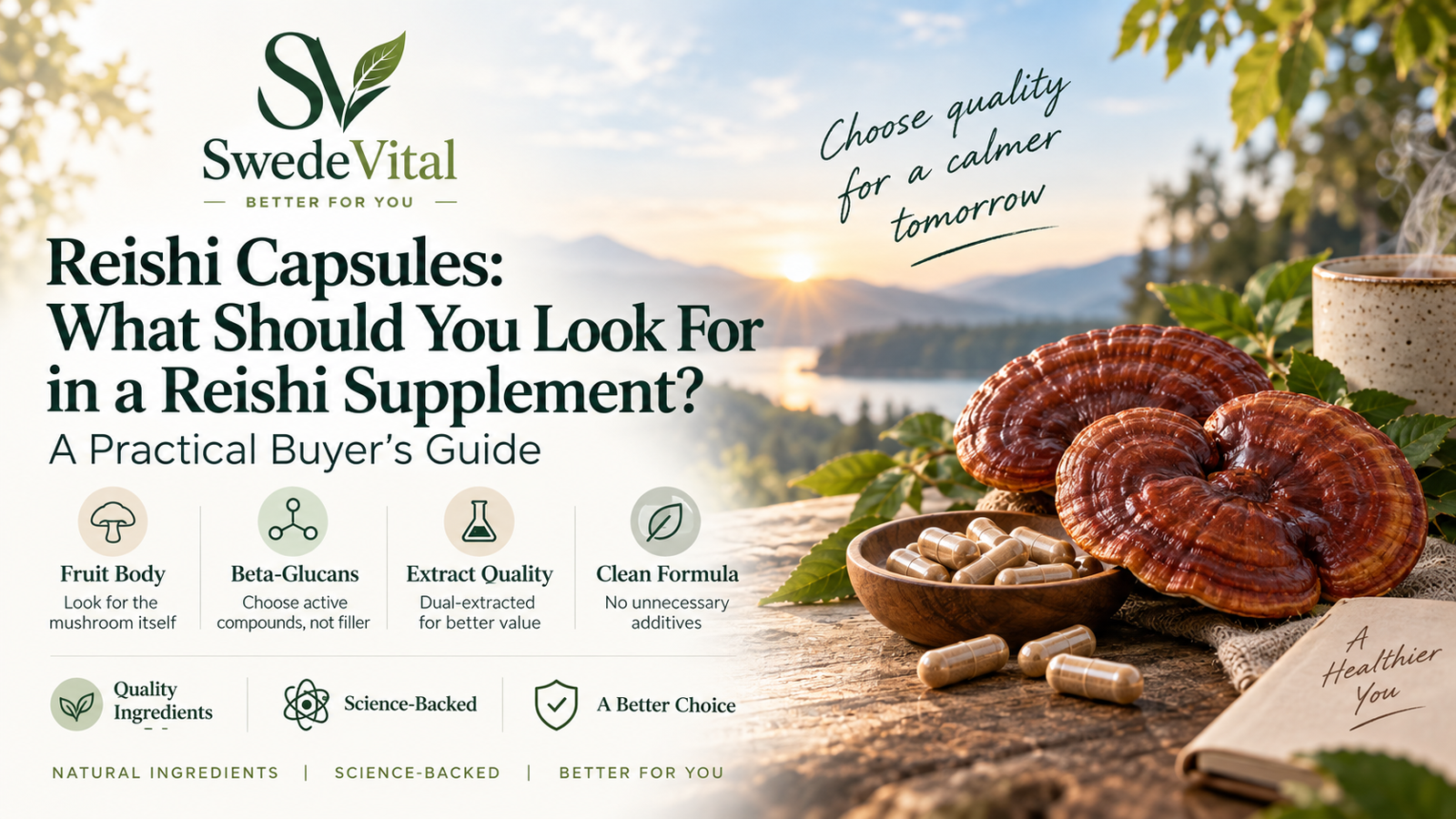
Look for Reishi capsules that use 100% fruiting body extract, list a specific beta‑glucan percentage, employ dual hot‑water and alcohol extraction, and provide third‑party lab results for heavy metals and microbes.
TL;DR
- High‑quality Reishi capsules feature 100% fruiting body, a clear beta‑glucan % from dual extraction, and independent lab testing.
Reishi capsules are an encapsulated form of Ganoderma lucidum, a woody medicinal mushroom used in traditional East Asian herbalism for well over two thousand years. For a buyer or a shopper the crucial point is this: not all Reishi capsules are equal. The species, the part of the mushroom used and the way it is processed change the product far more than the price on the shelf suggests. This guide explains what genuinely separates a high-quality Reishi supplement from a filler-heavy one, and gives you a checklist you can apply to any label.
In short, look for capsules made from concentrated fruiting body extract, with a stated beta-glucan percentage, a clear extraction ratio and current third-party lab testing for heavy metals and microbes. Everything else is secondary.
What Reishi is, and how it is traditionally used
Reishi (Ganoderma lucidum, known as lingzhi in China and reishi in Japan) is a hard, bitter, shelf-like fungus that grows on hardwood. In traditional systems it is classed as an adaptogen and has been traditionally used to support calm, restful sleep and a sense of resilience to everyday stress. In modern science it has been studied for its interaction with the immune system, sleep and stress response, largely on account of two groups of compounds: beta-glucans (a type of polysaccharide) and triterpenes (the intensely bitter compounds often called ganoderic acids).
Two points of honesty matter here. First, Reishi is a food supplement, not a medicine. Under EU rules it must not be presented as treating, preventing or curing any condition, and responsible suppliers keep their language to phrases such as traditionally used for and research suggests it may support. Second, the evidence is genuinely interesting in places and preliminary in others; a trustworthy brand will not overstate it. Apply that same discipline to any retail copy you build around the product, because compliant language protects both your customer and your listing.
Fruiting body versus mycelium: the single biggest quality question
This is where most of the real difference lives, and it is the first thing to establish about any Reishi capsule.
- Fruiting body is the actual mushroom you would recognise growing on a log. It carries the highest concentration of the beta-glucans and triterpenes people take Reishi for, and it is what traditional preparations have always used.
- Mycelium grown on grain is the root-like network cultivated indoors on a substrate of rice or oats. It is cheaper and faster to produce, but the finished powder is often harvested together with its grain substrate. The result can be largely starch, which inflates the headline "polysaccharide" figure without delivering the active beta-glucans a buyer actually wants.
So the decisive question is simple: does the capsule use 100% fruiting body? If a label reads "mycelium", "full-spectrum" or "myceliated grain" and does not publish a beta-glucan figure, treat it with caution. It may still be an honest product, but the burden of proof is on the brand to show what is inside.
Why extraction matters, and what "dual extraction" means
Reishi's cell walls are built largely from chitin, which the human gut cannot break down efficiently. Raw, ground Reishi powder therefore passes through with much of its value locked away. Extraction uses heat and solvents to rupture those walls and concentrate the active compounds into a far smaller, more bioavailable dose. This is why a well-made extract capsule can outperform a raw-powder capsule several times its size.
Reishi is a special case because its two headline compound families do not dissolve in the same medium. Beta-glucans are water-soluble, so they need a hot-water extraction. The triterpenes that give Reishi its bitterness are not fully water-soluble and need alcohol to draw them out. Dual extraction uses both hot water and alcohol, which is why it is considered the gold standard for Reishi specifically. A water-only extract can still be excellent for beta-glucans, but it leaves much of the triterpene fraction behind.
You will often see an extraction ratio such as 10:1 on the label. That means ten kilograms of raw mushroom were concentrated into one kilogram of finished extract. A higher ratio signals a more concentrated product, though the ratio alone is not proof of potency, which is exactly why the beta-glucan percentage still matters.
How to read the label on Reishi capsules
Look for beta-glucans, not just "polysaccharides"
"Polysaccharides" is a broad, generous term that happily includes the starch carried over from a grain substrate. The number that actually correlates with quality is the beta-glucan content, ideally measured by a validated enzymatic method rather than estimated by difference. A serious extract will state a specific beta-glucan percentage; a weak one tends to hide behind a large, vague total-polysaccharide figure. When you compare two products, compare beta-glucans, not marketing adjectives.
Check the strength, dose and everything else in the capsule
Read the extract weight per capsule and the recommended serving, so you can see the true daily dose rather than a flattering per-capsule number. Scan the ingredient list for bulking agents and unnecessary fillers, and confirm the capsule shell suits the customer you serve: vegan lines use plant-based HPMC or pullulan shells rather than gelatin. A clean label with a short ingredient list is usually a good sign that the brand is confident in the extract itself.
Testing, sourcing and transparency
Mushrooms are bioaccumulators, meaning they absorb whatever is present in their growing environment, including heavy metals such as lead, arsenic and cadmium. That single biological fact makes independent testing non-negotiable for any Reishi capsule you would put your name behind. Transparency here is the clearest signal of a supplier worth trusting.
- Heavy-metal testing by an independent, third-party laboratory, with results available on request or by batch.
- Microbial and contaminant testing covering yeast, mould and pathogens.
- Species identification and country of origin, so you know it is genuine Ganoderma lucidum and where it was grown.
- Relevant certifications for your channel, such as organic status, GMP manufacturing, and allergen or vegan declarations. Only ever claim the certifications a supplier can actually document.
For a private-label or wholesale buyer, this documentation is also your defence. If a claim or a contaminant question ever arises, a current certificate of analysis is what stands between you and a delisting.
A buyer's checklist for Reishi capsules
Use this as a quick scoring sheet. The strongest Reishi capsules on the market will tick almost all of these; anything missing three or more is worth a second look before you commit to a range.
- 100% fruiting body, clearly stated, not grain-grown mycelium.
- A concentrated extract with a declared extraction ratio, not raw powder.
- A stated beta-glucan percentage from a validated test, not a vague polysaccharide number.
- Dual extraction (hot water plus alcohol) to capture both beta-glucans and triterpenes.
- A current third-party lab report covering heavy metals and microbes.
- An unambiguous species name (Ganoderma lucidum) and country of origin.
- A clean ingredient list with a capsule shell that fits your customer base.
- Compliant, non-committal claims that never promise a medical outcome.
Where SwedeVital fits
SwedeVital develops its functional-wellness line, including Reishi alongside Lion's Mane, Cordyceps and Turkey Tail, around exactly the principles above: fruiting-body sourcing, extraction chosen for the mushroom in question, and documentation that a retail or private-label partner can stand behind. Reishi sits within a broader range that spans capsules, dual-extract sprays and gummies, so a buyer can match format to their shelf and their shopper without lowering the specification. The point of this article, though, is not the brand. It is that once you know to ask about fruiting body, extraction, beta-glucans and testing, you can evaluate any Reishi supplement on the market with confidence.
Frequently asked questions
Are Reishi capsules better than Reishi powder or tea?
Capsules made from a concentrated extract are usually more practical and more consistent in dose than raw powder, and they avoid Reishi's famously bitter taste. Traditional Reishi tea is a decoction (a long simmer), which is itself a form of water extraction; a good dual-extract capsule aims to deliver that concentrated benefit, plus the alcohol-soluble triterpenes, in a convenient form.
How much Reishi should you take?
There is no single official dose, and the right amount depends on the concentration of the specific extract, which is why the extraction ratio and beta-glucan figure matter. Follow the serving guidance on the product and, as with any supplement, consult a healthcare professional if you are pregnant, breastfeeding, on medication or managing a health condition.
When is the best time to take Reishi?
Reishi is traditionally associated with calm and rest, so many people take it in the evening. There is no strict rule, and consistency over time tends to matter more than the exact hour. Choose a routine the customer can actually stick to.
Are there any side effects or interactions?
Reishi is generally well tolerated as a food supplement, though some people report mild digestive upset. Because research suggests it may affect immune activity and blood clotting, anyone on immunosuppressant or anticoagulant medication, or approaching surgery, should speak to a doctor first. This is general information, not medical advice.
How do I know a Reishi capsule is genuine fruiting-body extract?
Look for an explicit "100% fruiting body" statement, an extraction ratio, a beta-glucan percentage and a batch-level certificate of analysis. If a brand cannot supply those on request, treat the claim as unverified.
Can Reishi capsules treat or prevent illness?
No. Reishi is a food supplement and must not be presented as treating, preventing or curing disease. It has been traditionally used and studied for support of sleep, stress resilience and immune function, but no guaranteed medical outcome should ever be claimed.
Related reading
- high‑quality Reishi product
- Reishi for everyday wellness
- Reishi format comparison
- functional mushroom guide
Sources
- The new EU regulation on nutrition and health claims: comments related to experiences from the Swedish Code of Practice
- Adaptogenic Effects of Mushroom Blend Supplementation on Stress, Fatigue, and Sleep: A Randomised, Double‐Blind, and Pla
- Best Reishi Supplement UK & Europe 2026: Log-Grown vs Bag-Grown
- Third-Party Supplement Testing Explained | Inventory Ready
- Ganoderma lucidum (Lingzhi or Reishi) - Herbal Medicine
Vanliga frågor
What is the difference between fruiting body and mycelium Reishi capsules?
Fruiting body capsules use the actual mushroom, providing higher beta‑glucan and triterpene levels, while mycelium capsules often contain grain substrate and lower active compounds.
Why is dual extraction important for Reishi?
Dual extraction uses hot water for beta‑glucans and alcohol for triterpenes, ensuring both key compounds are extracted and the capsule is more bioavailable.
How can I verify the quality of a Reishi capsule?
Check for a stated beta‑glucan percentage, a clear extraction ratio, 100% fruiting body claim, and independent third‑party lab testing for heavy metals and microbes.
What does a high extraction ratio indicate?
A higher ratio (e.g., 10:1) means more raw mushroom was concentrated into the final extract, suggesting a more potent product, though beta‑glucan % remains the definitive quality marker.
Are there any fillers I should avoid in Reishi capsules?
Yes, avoid capsules with large amounts of bulking agents or unnecessary fillers; a short, clean ingredient list usually indicates a higher‑quality product.