Reishi Benefits: What Has This Functional Mushroom Been Studied For?
Kort sammanfattat
Reishi (Ganoderma lucidum) is a functional mushroom traditionally used to support relaxation and vitality. Research has most often studied it for immune modulation, sleep and antioxidant activity, though evidence is still early and no authorised EU health claims exist. It is best described in evidence-led, non-committal terms rather than as a remedy.
TL;DR
- Reishi is a traditionally used functional mushroom studied mainly for immune, sleep and stress support: promising but preliminary, and best sold with honest, non-committal messaging.
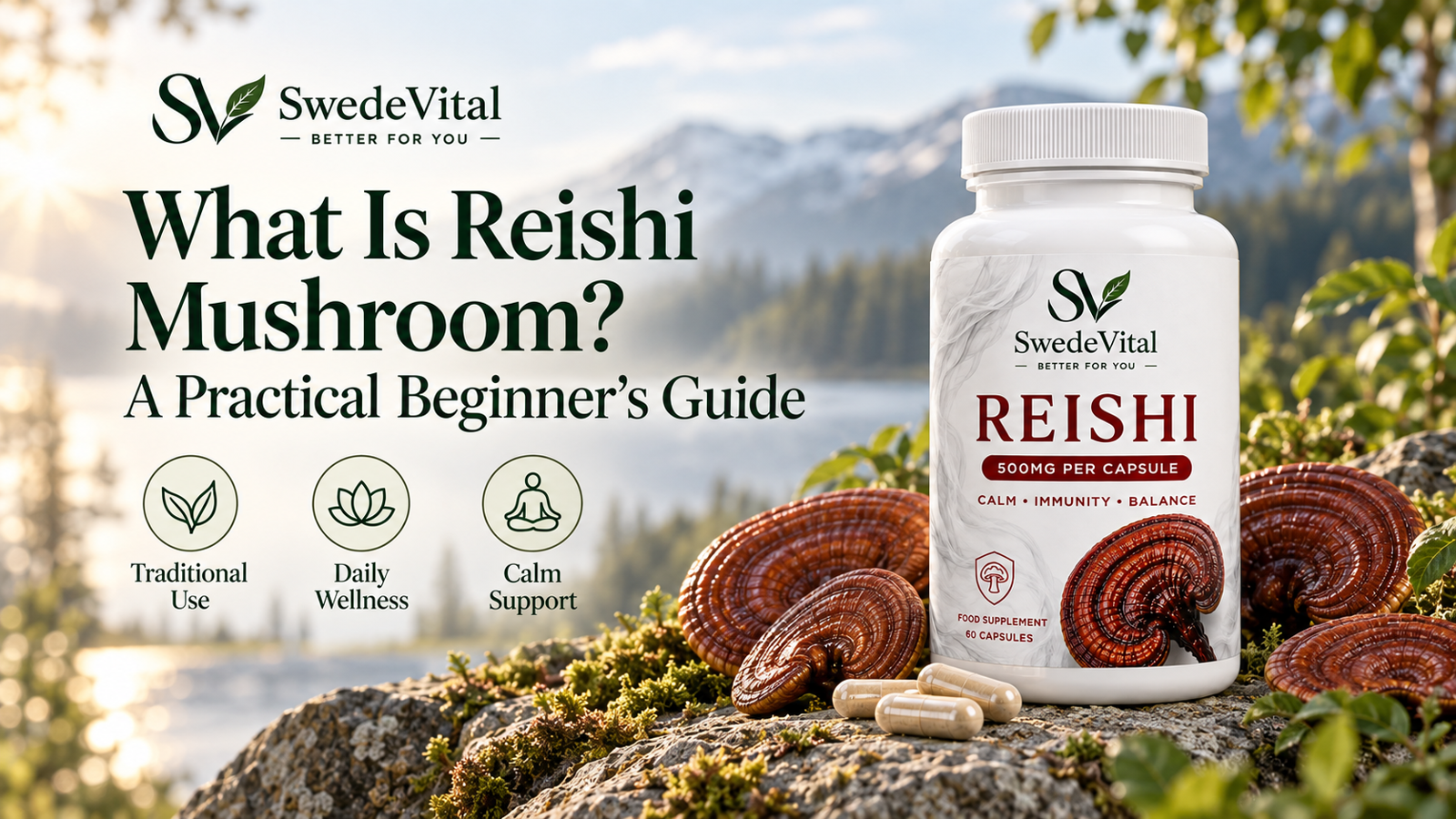
Reishi (Ganoderma lucidum), known as lingzhi in China and reishi in Japan, is a woody functional mushroom that has featured in East Asian wellness traditions for more than two thousand years. When buyers and shoppers ask about Reishi benefits, the honest, evidence-led answer is that modern research has most often explored its bioactive compounds for a potential role in supporting immune balance, sleep quality, stress resilience and general vitality — while stressing that most studies remain early-stage and that no authorised EU health claims currently exist for it.
This primer is written for retail buyers and category managers who need to understand what they are stocking, and for the informed consumers they serve. It sets out what reishi is, what it has actually been studied for, how the different formats compare, and how to judge quality — without overstating the science.
What is Reishi, and why has it been valued for so long?
Reishi is the common name for Ganoderma lucidum and several closely related species in the Ganoderma genus. In the wild it grows as a shelf-like, reddish-brown bracket on hardwood, and its glossy, lacquered cap earned it the poetic title "mushroom of immortality" in classical Chinese texts. Historically it was reserved for royalty and prepared as a tonic rather than eaten as food, because the raw fruiting body is tough, bitter and fibrous.
That bitterness is a clue to its chemistry. Reishi is unusually rich in a class of compounds called triterpenes (including the ganoderic acids), which give it its characteristic taste, alongside the beta-glucan polysaccharides found across many functional mushrooms. It is this particular combination that researchers have spent the last few decades trying to understand.
What has the research on Reishi benefits actually examined?
It is important to frame this carefully. Much of the evidence for Reishi benefits comes from laboratory and animal studies, with a smaller and more mixed body of human trials. The areas that have attracted the most scientific attention are:
- Immune modulation. Reishi's polysaccharides have been studied for how they may interact with immune cells. Research suggests a modulating rather than simply "boosting" effect, but robust human data remain limited.
- Sleep and relaxation. Reishi is traditionally taken in the evening, and some early studies have looked at whether it may support calm and sleep quality. This is one reason it is positioned differently from the more energising Cordyceps or Lion's Mane.
- Stress and general resilience. Reishi is frequently described as an "adaptogen" in traditional contexts — something used to help the body cope with stress — though this is a traditional framing rather than a confirmed clinical outcome.
- Antioxidant activity. Laboratory work has measured the antioxidant capacity of reishi extracts, which is part of the wider interest in its triterpene content, though laboratory antioxidant readings do not automatically translate into a benefit inside the body.
The responsible summary is this: reishi has been studied for these areas, and traditional use points in the same direction, but the strength of evidence varies and none of it supports treating, curing or preventing any disease.
For retailers, the safest and most credible position is to describe reishi in terms of tradition and ongoing research — "traditionally used to support relaxation", "studied for its role in immune balance" — and never as a remedy.
The active compounds behind the interest
Understanding two compound families helps buyers ask suppliers the right questions and read a label critically.
Triterpenes (ganoderic acids)
These are largely responsible for reishi's bitter taste and are concentrated in the fruiting body. They are only sparingly soluble in water, which means they have to be drawn out with alcohol. A product that claims meaningful triterpene content should therefore be made with a dual extraction, described below.
Beta-glucan polysaccharides
These water-soluble compounds are shared with other medicinal mushrooms and are the focus of most immune-related research. They are pulled out with hot water. Reputable suppliers test and disclose beta-glucan percentages specifically, rather than quoting vague "polysaccharide" figures that can be inflated by added starch.
Format matters: capsules, sprays and gummies compared
Reishi reaches shelves in several formats, and each involves a genuine trade-off. SwedeVital's functional-wellness line spans capsules, dual-extract sprays and gummies precisely because different shoppers prioritise different things.
- Capsules deliver a defined amount of extract with no taste, making them the easiest daily-routine format. They suit shoppers who already take supplements and value convenience over experience.
- Dual-extract sprays use both water and alcohol extraction, capturing the water-soluble beta-glucans and the alcohol-soluble triterpenes. Sprays offer fast, flexible dosing and appeal to shoppers who want a concentrated liquid — though the natural bitterness of a true reishi extract is more noticeable in this format.
- Gummies lower the barrier for newcomers and taste pleasant, but they carry added sugars or sweeteners and typically a lower extract load. They are best understood as a gentle entry point rather than a high-potency option.
The single most important quality signal across all three formats is dual extraction. Because reishi's most-studied compounds split between water-soluble and alcohol-soluble fractions, a water-only extract or a raw milled powder simply cannot represent the full spectrum the research describes.
A buyer's checklist for choosing quality Reishi
Whether you are sourcing for a shelf or building a private-label line, these are the questions that separate a credible product from a commodity:
- Extract, not just powder. Is it a concentrated extract with a stated ratio, or milled fruiting-body powder? Both have a place, but they are not interchangeable in strength.
- Dual extraction. Does the process capture both the water-soluble beta-glucans and the alcohol-soluble triterpenes?
- Fruiting body versus mycelium. Ask which part is used. Fruiting-body extracts are generally preferred for triterpene content; mycelium grown on grain can dilute active compounds with residual starch.
- Beta-glucan disclosure. Are beta-glucans quantified specifically, ideally through third-party testing?
- Contaminant testing. Because mushrooms concentrate what they grow on, look for testing on heavy metals and microbial safety.
- Honest labelling. Does the marketing stay within evidence-led, non-committal language, or does it over-promise? Over-claiming is a compliance risk you inherit the moment you stock it.
One further consideration matters for private-label partners: reishi's strong, bitter flavour profile shapes what is achievable in each format. A high-extract gummy that still tastes pleasant is far harder to formulate than a neutral capsule, so ambitious potency and enjoyable taste can pull against each other. Agreeing the target extract strength, the flavour approach and the testing regime up front avoids expensive reformulation later and keeps the finished product honest about what it actually delivers.
Who considers Reishi, and what should be flagged on safety?
Reishi is generally positioned for adults interested in long-term wellness routines, relaxation and immune support, and it is often chosen for evening use. As with any food supplement, it is not a substitute for a varied, balanced diet or for medical care.
A few points are worth communicating clearly to customers. Reishi may interact with blood-thinning and blood-pressure medication, and its effect on the immune system means anyone who is immunosuppressed, pregnant, breastfeeding or taking prescription medication should speak to a healthcare professional before use. Reported side effects are usually mild, but honest safety guidance builds far more trust than silence.
Where Reishi fits alongside other functional mushrooms
Buyers rarely stock reishi in isolation, so it helps to position it against its shelf-mates. Lion's Mane is most studied for cognitive and nervous-system support, Cordyceps for energy and endurance, and Turkey Tail for its well-characterised beta-glucans and immune research. Reishi's distinct niche is the calming, evening, wind-down end of the range. Presenting the four as a considered system — rather than interchangeable options — tends to lift both basket size and customer confidence.
In short, the credible story around reishi mushroom benefits is one of deep tradition combined with active, ongoing research. Stock it with accurate, non-committal messaging and a quality specification you can defend, and reishi becomes a durable category rather than a passing trend.
Reishi benefits: frequently asked questions
What is Reishi mushroom used for?
Traditionally, reishi has been used to support relaxation, restful sleep and general vitality, and it is often taken in the evening. Modern research has studied it mainly for immune modulation and antioxidant activity, though evidence is still developing and no disease-related claims are permitted.
How long does Reishi take to work?
Reishi is generally viewed as a slow, cumulative tonic rather than a fast-acting supplement, so it is typically used consistently over several weeks. Individual responses vary, and no specific outcome or timeframe can be guaranteed.
Is it better to take Reishi in the morning or at night?
Because of its traditional association with calm and relaxation, reishi is most often taken in the evening. There is no strict rule, however, and the best time ultimately depends on personal routine and preference.
What is the difference between Reishi capsules, sprays and gummies?
Capsules offer convenient, taste-free daily dosing; dual-extract sprays provide a concentrated liquid that captures both water- and alcohol-soluble compounds; and gummies are a gentle, better-tasting entry point that usually contains a lower extract load and some added sweeteners.
Are there any side effects or precautions with Reishi?
Reported side effects are usually mild, but reishi may interact with blood-thinning or blood-pressure medication. Anyone pregnant, breastfeeding, immunosuppressed or taking prescription medication should consult a healthcare professional before using it.
Vanliga frågor
What is Reishi mushroom used for?
Traditionally, reishi has been used to support relaxation, restful sleep and general vitality, and it is often taken in the evening. Modern research has studied it mainly for immune modulation and antioxidant activity, though evidence is still developing and no disease-related claims are permitted.
How long does Reishi take to work?
Reishi is generally viewed as a slow, cumulative tonic rather than a fast-acting supplement, so it is typically used consistently over several weeks. Individual responses vary, and no specific outcome or timeframe can be guaranteed.
Is it better to take Reishi in the morning or at night?
Because of its traditional association with calm and relaxation, reishi is most often taken in the evening. There is no strict rule, however, and the best time ultimately depends on personal routine and preference.
What is the difference between Reishi capsules, sprays and gummies?
Capsules offer convenient, taste-free daily dosing; dual-extract sprays provide a concentrated liquid that captures both water- and alcohol-soluble compounds; and gummies are a gentle, better-tasting entry point that usually contains a lower extract load and some added sweeteners.
Are there any side effects or precautions with Reishi?
Reported side effects are usually mild, but reishi may interact with blood-thinning or blood-pressure medication. Anyone pregnant, breastfeeding, immunosuppressed or taking prescription medication should consult a healthcare professional before using it.