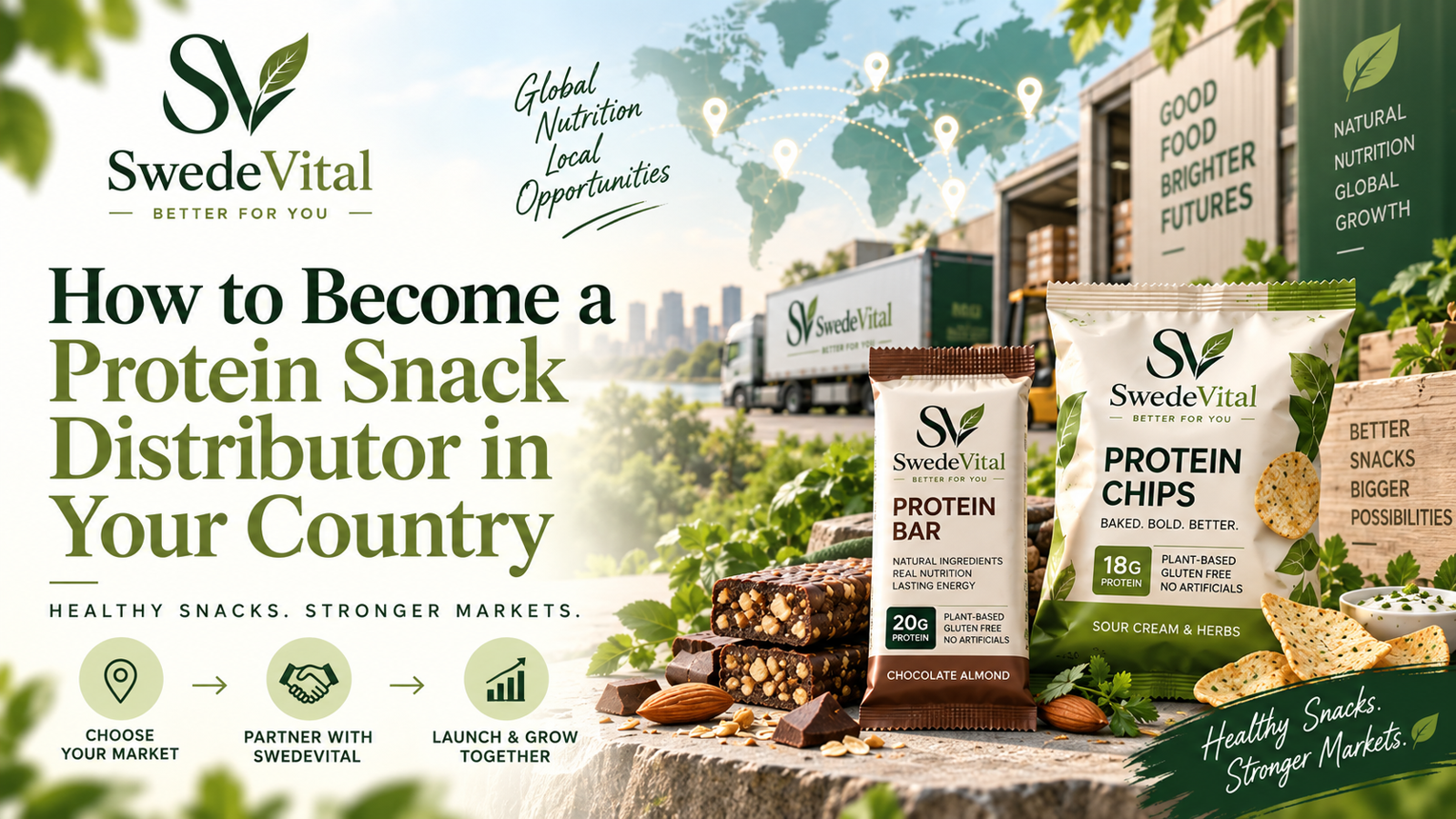
How to Become a Protein Snack Distributor in Your Country
Kort sammanfattat
To become a protein snack distributor, validate local demand, choose a distribution model (exclusive, non‑exclusive, or private label), register your food business, confirm labelling and import rules, secure an auditable manufacturer, then build retail listings with margins and logistics that hold up.
TL;DR
- Validate demand, pick a distribution model, comply with food‑safety rules, secure a reliable supplier, and launch retail listings to start a protein snack distribution business.
Short answer: to become a protein snack distributor, validate real local demand, choose a supply model (exclusive, non-exclusive or private label), register your food business and confirm labelling and import rules, secure a manufacturer you can audit, then build retail listings with margins and logistics that hold up. Start narrow, prove sell-through, then scale.
Successful distributors treat distribution as a working-capital business first, sequencing decisions so cash goes into stock only after demand, compliance and supply are reasonably de-risked. This guide walks buyers and would-be distributors through that sequence, from market read to first shelf.
What a protein snack distributor actually does
A distributor sits between the manufacturer and the retail shelf. You buy stock in volume, hold inventory, manage warehousing and last-mile logistics, and typically own the commercial relationship with the stores that carry the product. That differs from a broker or sales agent, who introduces a product for commission but never takes ownership of goods, and from a pure importer, whose role may end at customs clearance.
The distinction matters because it defines where your risk and margin live. Taking title to inventory means you carry the cost of goods, storage, shrinkage and returns, but you also capture the trade margin and control availability. Many first-time operators underestimate the working-capital cycle: you pay the manufacturer on their terms, hold stock for weeks, and only recover cash once retailers pay on theirs. Model that gap before anything else.
Is there room for another protein snack distributor in your market?
Demand validation is the cheapest insurance you can buy. Before committing to stock, audit what is already on shelf in your target channel: the price ladders, the formats (bars, bites, chips, clusters), the claims that dominate (high-protein, plant-based, low-sugar, allergen-free) and, critically, the gaps. A market saturated with whey bars but thin on plant-based, high-protein savoury options is telling you where a new listing can earn its facing.
It is also worth understanding how snacks relate to the wider protein category. Search demand for protein powder dwarfs almost every snack term, which tells you the category intent is enormous and that shoppers already think in grams of protein per serving. Powders win on cost-per-gram and the dedicated fitness occasion; snacks win on convenience, impulse and repeat purchase away from the kitchen. A category manager stocking protein powder is often the same buyer who wants a credible grab-and-go range beside it. Position your snacks as the format that captures the shopper when a shaker is not an option, and you extend an established demand curve rather than inventing one.
Translate the read into one hypothesis: which shopper, buying what format, at what price, in which channel, and why yours over the incumbent. If you cannot answer that clearly, you are not ready to buy stock.
Choose your distribution model
Exclusive versus non-exclusive
An exclusive territory agreement gives you the sole right to sell a brand in a defined region. It rewards the investment you put into building the market and protects you from a competitor undercutting your listings. The trade-off is commitment: exclusivity usually comes with volume obligations and a duty to develop the territory, so it suits distributors ready to put real sales effort behind one line. A non-exclusive arrangement lowers your obligations and lets you build a broader portfolio, but you may find the same product landing next to yours at a different price.
Private label versus branded
Distributing an established brand means you inherit its recognition, marketing and formulation, competing mainly on service and availability. Private label, where a manufacturer produces to your specification under your own brand, hands you control of positioning, margin and the customer relationship, at the cost of building recognition from scratch and carrying more product responsibility. Many operators run a hybrid: a branded range to open doors quickly, a private-label line to grow margin once they understand the shelf. A manufacturer with both capabilities, spanning plant-based protein snack ranges and a functional wellness line, gives you room to evolve without changing supplier.
Get the food-safety and labelling groundwork right
Distributing food is a regulated activity, and the rules are non-negotiable. In the EU and much of Europe, packaged food must carry mandatory consumer information, including a legible ingredient list, allergen emphasis, a nutrition declaration and clear net quantity and durability dates, under the food-information framework (Regulation (EU) No 1169/2011). Any nutrition or health messaging, such as claims about protein content or a benefit, is separately governed by the Nutrition and Health Claims Regulation (1924/2006) and must use only authorised wording. Treat marketing copy as a compliance surface, not a creative one.
Practically, you will usually register as a food business operator with the competent authority in your country, put a HACCP-based food-safety system in place for storage and handling, and confirm who bears legal responsibility for the label. When you import from outside your territory, that responsibility, and the name and address on pack, often falls to you as the operator placing the product on the market. Confirm import duties, VAT treatment and any product-specific rules before you order, not after the pallet arrives. Functional or supplement-style products such as capsules, sprays or gummies carry extra category-specific requirements on top of general food law.
Rule of thumb: if a claim or a label detail cannot be evidenced from the manufacturer's documentation, do not put it in front of a buyer. Compliance gaps surface at the worst possible moment, on a listing you have already fought to win.
Vet your supplier like a category manager would
Your supplier is your single biggest source of both quality and risk. Diligence here protects every listing downstream. Work through a structured checklist before you place a first order:
- Certifications and audits. Ask for current food-safety certification and recent audit results, and confirm they cover the specific site and lines making your product.
- Full specification sheets. Request ingredient declarations, allergen statements, nutrition data and shelf-life documentation you can hand to a buyer without editing.
- Batch traceability and recall process. Confirm they can trace any batch forwards and backwards and that a recall procedure exists and has been tested.
- Capacity and lead times. Understand realistic production capacity, minimum runs and lead times, so a sudden reorder does not leave a shelf empty for a month.
- Consistency and samples. Taste and inspect across multiple production dates, not a single golden sample, and check that pack and print match spec.
- Commercial terms. Clarify pricing tiers, payment terms, who owns freight and insurance, and how defects or short deliveries are handled.
- Roadmap and flexibility. A supplier who can add formats, adjust recipes for local taste, or support private label gives you room to grow without re-sourcing.
Insist on documentation you can forward untouched. The retail buyers you will pitch expect the same paperwork, and a supplier who cannot produce it quickly is telling you something important.
Build pricing and margins that survive retail
Distributor economics only work if the whole chain can make money at a price the shopper will pay. Build the price ladder from the shelf down: start with a realistic retail price for your format and quality, subtract the retailer's expected margin, then your own operating margin and logistics cost, and see what landed cost you can afford. If the manufacturer's price leaves no room, the deal is broken no matter how good the product is.
Protect that structure. Model in the costs first-timers forget: freight and duty, warehousing, breakage and short-dated stock, returns, and the promotional allowances retailers expect to fund launch. Keep a clear wholesale price list with volume tiers so larger accounts are rewarded without eroding your floor, and avoid discounting into channels that will later cannibalise your best customers. Healthy distribution is steady margin on reliable volume, not heroic markups on erratic orders.
Land the first retail listings
Your first ten accounts are worth more than the next hundred, because they become your proof of sell-through. Start where the decision cycle is short: independent stores, gyms, cafes, health-food retailers and specialist online sellers can list you in days, not quarters. Then use the sales data from those accounts, not a pitch deck, to approach larger chains, whose category reviews run on fixed calendars and hard evidence.
When you pitch, sell the category, not just the product. A buyer wants to know how your line grows their protein or better-for-you segment, how it merchandises, what marketing support comes with it, and how confident they can be in supply. Come with clean specifications, samples across dates and honest availability commitments. Reliability, in food distribution, is a competitive advantage in its own right; the distributor who never leaves a gap on shelf earns the next listing.
A phased launch plan
Sequencing keeps risk contained. A workable path looks like this:
- Phase 1 — Validate. Audit the shelf, confirm the gap, and write your one-paragraph positioning before spending on stock.
- Phase 2 — Comply. Register your food business, confirm labelling and import rules, and lock down who owns label responsibility.
- Phase 3 — Source. Complete supplier diligence, sample across batches, and agree commercial terms in writing.
- Phase 4 — Prove. Launch a focused range into fast-moving independent accounts and measure genuine sell-through.
- Phase 5 — Scale. Use real data to enter category reviews, add formats, and consider private label to grow margin.
Move to the next phase only when the previous one has earned it. That discipline separates distributors who build a durable business from those liquidating slow stock a year in.
Protein snack distributor FAQs
How much capital do I need to start distributing protein snacks?
There is no universal figure; it depends on your minimum order quantities, payment terms, warehousing and how long retailers take to pay. Model the cash cycle instead: money leaves when you pay the manufacturer and returns only when retailers settle, so size working capital to bridge that gap plus a buffer for slower stock.
Do I need a licence to distribute food?
In most European markets you must register as a food business operator with your national authority and run a food-safety system based on HACCP principles. Requirements vary by country and product type, and supplement-style functional products often carry extra rules, so confirm your obligations with the local competent authority before trading.
Should I distribute protein snacks or protein powder?
They serve different occasions. Protein powder has enormous, cost-driven demand tied to the dedicated fitness routine, while snacks win on convenience, impulse and repeat purchase on the move. Many distributors carry both, so a single retail buyer can build a complete protein set from core shopper to away-from-home occasion.
Is private label better than distributing an established brand?
Neither is universally better. A known brand opens doors faster and shares the marketing load; private label gives you control of margin, positioning and the customer relationship but asks you to build recognition and carry more product responsibility. A common approach is to lead with a branded range and add private label once you understand the shelf.
How do I win my first retail listings?
Begin with accounts that decide quickly, such as independents, gyms and specialist retailers, and use their real sell-through data to approach larger chains during category reviews. Pitch the category rather than the single product, bring clean documentation and consistent samples, and back it with dependable availability.
What is the most common mistake new distributors make?
Buying stock before validating demand and compliance. Committing cash to inventory feels like progress, but stock that stalls on an unproven listing is the fastest way to run short of working capital. Validate, comply and secure supply first; buy inventory only once the market read is real.
Related reading
Sources
- Determination of the Popularity of Dietary Supplements Using Google Search Rankings
- Regulation (EU) No 1169/2011 of the European Parliament and of the Council of 25 October 2011 on the provision of food i
- Nutrition and health claims: guidance to compliance with Regulation (EC) 1924/2006 - GOV.UK
- Allergies - Food Safety - European Commission
- Becoming an importer, commercial agent, or broker | Business.gov.nl
- Protein Snacks Market Size, Share & Trends | Forecast [2034]
Vanliga frågor
What is the first step to becoming a protein snack distributor?
Validate real local demand by auditing existing shelf offerings and identifying gaps in the market.
How does an exclusive distribution agreement differ from a non‑exclusive one?
An exclusive agreement gives you sole rights in a region but requires volume commitments and territory development, while a non‑exclusive arrangement lowers obligations but allows competitors to sell the same product.
What food‑safety and labelling requirements must I meet?
Register as a food business operator, implement a HACCP‑based system, ensure mandatory ingredient lists, allergen emphasis, nutrition declarations, and comply with the Nutrition and Health Claims Regulation.
When should I secure a manufacturer?
After you have a clear hypothesis on shopper, format, price, channel, and why your product will win—so you can audit the supplier before committing to stock.
Can I use a private label to grow margins?
Yes, a private label lets you control positioning and margin, but it requires building brand recognition from scratch and carrying more product responsibility.